
Toxic Beauty: Hidden Harm Beneath the Surface
Saturday, April 11 – Saturday, May 16, 2026,
Sinclair Gallery @ ArtsXchange, East Point, Georgia
Artist Talk: Saturday, May 16, 3-5pm
Curated by ArtsXchange Gallery Director Ric Washington
Guest Juror: Ralph rEN Dillard
Toxic Beauty brings together 12 artists examining the tension between attraction and harm. The exhibition asks a direct question: what lies beneath the surfaces we admire? Through painting, photography, and mixed media, the work reveals how beauty can mask environmental damage, cultural pressure, consumer excess, and unseen personal and social costs. The result is a thoughtful, visually engaging exhibition that challenges viewers to look closer and think more critically about what we value.
Exhibition Awards
This year’s juried selections recognize artists whose work most powerfully engage the theme:
1st Place: “We Could be Twins” by Tony Smart, Archival Pigment Photo Print

This piece, "We Could Be Twins" is part of my series The Barbie Affect is based on the 1954 White Doll test first conducted in Harlem NY. by Dr. Kenneth Clark and his wife Mamie Clark. During the test, black boys and girls were presented with two dolls, one white and one black. The children were then asked, which dolls did they consider good, pretty, bad and smart. In most cases, the black children choose the white doll over the black doll that looked like them. The conclusion confirmed that these black children ages 3-7 already had damaged self-esteem resulting from prejudice, discrimination, and segregation. Ironically, another White Doll test was conducted in 2021 by Dr. Tony Sturtevant of Texas A&M with almost identical results.
_________________________________________________________________________
2nd Place: “identity theft: id bracelets, no id” by F. Geoffrey Johnson,
Top Assemblage: oak wood, wire, metal id bracelets, human hair, deconstructed aṣọ òkè Ghanaian hand-woven cotton fugu (smock), acrylic medium, galvanized steel hardware cloth, iron chain, ceramic beads.
Bottom Assemblage: oak wood, wire, id bracelets, human hair, deconstructed aṣọ òkè Ghanaian hand-woven cotton fugu (smock), acrylic medium, galvanized steel hardware cloth, iron chain, beads

This work of art is created within the context of addressing the relevance, significance, detriment, and racial angst of a naming system brought about by the institution of slavery and the stripping of human identifiers of an enslaved people (name, place of origin, language).
Hundreds of ID bracelets with multicolored patina, sans engraved names, represent millions of enslaved individuals and descendants of the enslaved, in the Americas, stripped of their ancestral lineage and identity. Human hair locs complement the bracelets providing DNA evidence of this rape. Beads have been documented as having been used as trade capital. The oak board was part of a Georgia, USA courthouse record room table which was used to hold property record books, including recordings of property and documents, chattel slave records inclusive.
_________________________________________________________________________
3rd Place: “The Other Woman” by Michael Morgan, Acrylic on Canvas
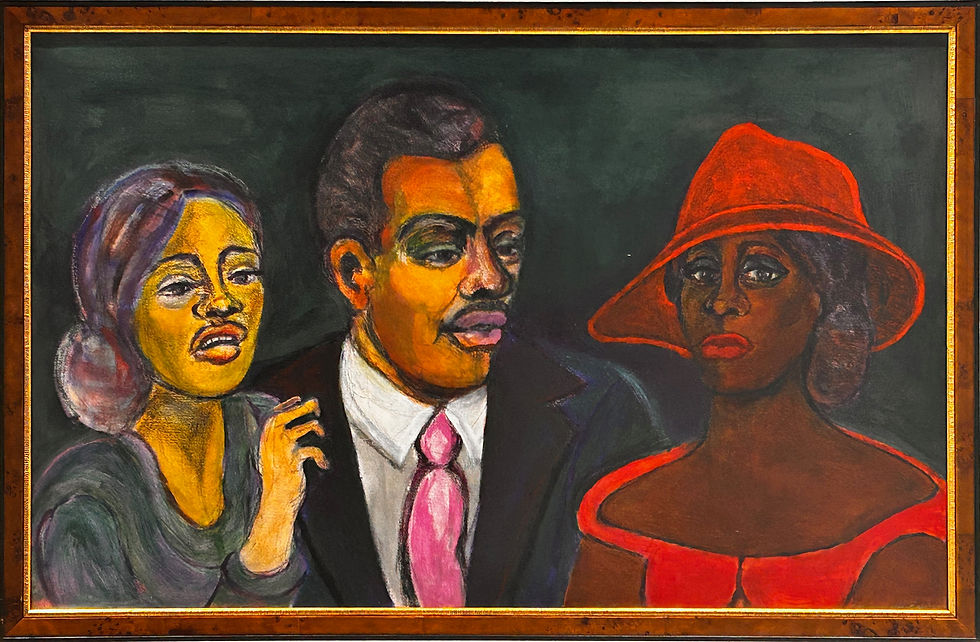
ARTIST STATEMENT: The Other Woman depicts a man suspended between two women, his wife and the woman with whom he is having an affair. Rather than clearly identifying each role, the painting deliberately withholds this information, leaving the viewer to determine which woman occupies which position in the relationship. The composition centers on tension, ambiguity, and perception. The three figures form a charged triangular arrangement that suggests emotional conflict and competing claims of intimacy. While the man stands
between them, the real focus of the work lies in the uncertainty surrounding the two women and the shifting assumptions viewers may bring to the scene.
By refusing to label the figures, the painting invites the audience to question how they read relationships through gesture, proximity, expression, and bias. The act of deciding who is the wife and who is “the other woman” becomes part of the viewing experience, revealing how easily narratives are constructed from limited visual cues.
The Other Woman ultimately explores themes of desire, loyalty, and perception, asking viewers to confront their own interpretations while recognizing the instability of the stories they create.
______________________________________________________________________
Honorable Mention: “Ultra Real, Ultra-Processed Life” by Clementine Willowilde, Reclaimed Product Packaging

ARTIST STATEMENT: My artwork explores the environmental impact of ultra-processed foods (UPFs) and their packaging, revealing the hidden consequences of production and consumption on greenhouse gas emissions, land and water use, and biodiversity loss. Product packaging, particularly plastic, accounts for nearly 40% of global waste and rarely returns to nature without harm. Through this work, I invite viewers to reconsider their relationship to food systems and waste, encouraging a shift toward sustainability. I
advocate for extended producer responsibility, where corporations take accountability for a product’s full life cycle, fostering recycling and resource efficiency. By deepening awareness, the work calls for conscious consumption and collective action to reduce environmental waste.


